

Introduction
The term “civilizational war” has gained significant attention in recent years, especially after the military aggression by the United States and the Zionist regime against Iran in February 2026, which coincided with the holy month of Ramadan and came to be known as the Ramadan War. However, the key question is: what makes a war truly civilizational in nature, and can the Ramadan War be considered as such? Civilization, closely linked to culture, represents an intellectual, scientific, and practical framework that starts from foundational beliefs and values, extends through various sciences and knowledge systems, and ultimately manifests in technology and lifestyle. What elevates a social system to the level of a civilization is its ability to develop a coherent worldview across all dimensions of human life and present a distinct way of living to humanity. All modern-era wars, from the religious wars of 16th and 17th century Europe to the world wars of the 20th century, took place within the boundaries of modern civilization, and none of them aimed to transcend its ideals. In this context, the Islamic Revolution of Iran marked the beginning of an unprecedented encounter between Iranian-Islamic civilization and Western civilization, setting the stage for a war with an entirely different nature. This paper aims to demonstrate that the Ramadan War is not merely a civilizational war, but rather the only civilizational war of the modern era, one that emerged from the historical confrontation between two distinct civilizations and crossed the identity boundaries of modernity.
The Civilizational Dimensions of the Ramadan War within the Iranian-Islamic and Western Civilizational Encounter
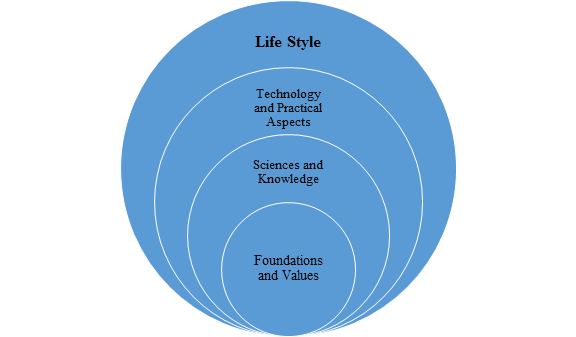
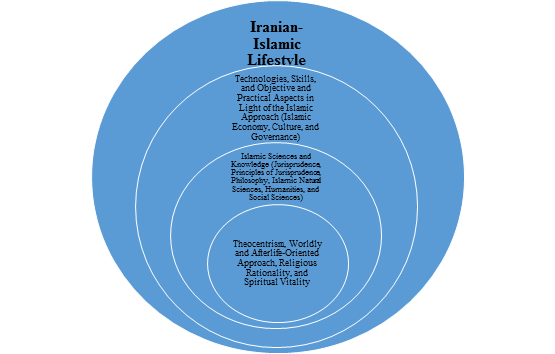
To analyze and explain a culture and civilization, we can use a layered model in which the core consists of intellectual and value-based foundations. These foundations shape the identity and direction of a civilization across various domains. The second layer comprises the sciences and knowledge systems that develop based on this core, expanding and refining those foundational principles in the realm of human understanding. The third layer includes the practical aspects, technologies, and skills that arise from these sciences, and finally, the outermost layer—the most visible and tangible expression of a civilization—is its lifestyle. These four layers function in a coordinated and mutually influential system, with the primary direction of a civilization’s development flowing from the inside (intellectual foundations) outward (lifestyle). Accordingly, the fundamental distinction between civilizations throughout history lies primarily in their intellectual and value-based foundations, and these differences shape their perspectives on humanity, society, and history. This layered structure is illustrated in Figure 1.
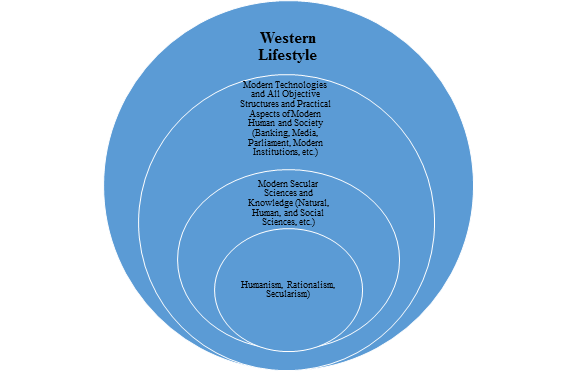
Using this analytical model, we can compare Western and Iranian-Islamic civilizations. Western civilization, emerging from the Renaissance and particularly the Enlightenment, was built on three key pillars: humanism (human-centeredness), rationalism (instrumental reason), and secularism (the separation of religion from social spheres). Based on these foundations, it organized its sciences to dominate nature and maximize the exploitation of resources, using advanced technology to establish political, economic, and legal systems grounded in individual and collective interests. In this framework, individual freedom and rights in their secular sense became the core of social relations, and religion was confined to private life. This gradual shift led to an extreme form of anthropocentrism in which humanity became the sole measure of all things, and any transcendental authority, including divine revelation, was excluded from social and civilizational affairs. Rooted in Renaissance and Enlightenment thought, this movement sought to build a new order based solely on human reason, yet this reason, disconnected from divine sources, eventually faced deep crises, including Nihilism and existential emptiness. The layers of this civilization are depicted in Figure 2.
In contrast, Iranian-Islamic civilization, revived through the Islamic Revolution of 1979, is founded on monotheistic principles and divine teachings. It views humans not as self-sufficient and self-legislating beings, but as servants and vicegerents of God, whose ultimate purpose is spiritual growth through devotion and servitude. In this view, knowledge is not for controlling nature or securing material benefits alone, but for better understanding God, nature, and the self, and ultimately, for organizing life according to divine will. Accordingly, political, economic, and legal systems are shaped by divine law, and lifestyle becomes the concrete manifestation of this worldview. This perspective assigns responsibilities beyond personal gain and sees true happiness in obedience to God and the pursuit of spiritual perfection. These two worldviews are not only distinct but fundamentally opposed, as each charts a different path and ultimate goal for humanity. Figure 3 illustrates the layers of Iranian-Islamic civilization.
What turns a war into a civilizational war is not its geographical scope or the number of countries involved, but its place within a comprehensive confrontation across various cultural and civilizational layers. In a civilizational war, the conflicting parties face each other with opposing intellectual and value foundations, and each refuses to recognize the other’s civilizational legitimacy. This confrontation begins at the level of thought and knowledge and extends to the most visible layers—lifestyle and, ultimately, military conflict. In such a context, confrontation is not merely military; rather, every layer of civilization—education, science, art, architecture, law, economy, and even daily customs and rituals—becomes an arena for contesting and proving the superiority of one value system over another. None of the modern-era wars, including the world wars, qualify as civilizational wars, because both sides were defined within the same framework of modern intellectual and value-based principles. Their differences lay in various secular ideologies such as liberalism, socialism, fascism, and Nazism, all rooted in Western culture and civilization. Despite their massive geographical spread and human toll, these wars never sought to transcend modernity’s core beliefs; rather, they aimed to realize variations of ideologies born within it. However, the Islamic Revolution of Iran introduced a different model, emerging as a civilizational and historical movement outside modernity’s boundaries, and initiated an unprecedented confrontation. This confrontation continued for nearly half a century across cultural, scientific, economic, political, and legal arenas. The Islamic Republic of Iran, drawing on principles such as supporting the oppressed, defending Muslim rights, and refusing to align with hegemonic powers (Articles 3, 152, and 154 of its Constitution), adopted an approach entirely distinct from the conventional logic of Western foreign policy, effectively challenging the hegemony of major powers. This approach was not merely political but rooted in a different ontological and anthropological perspective, which viewed solidarity with the world’s oppressed and resistance against tyranny not as tactical choices, but as fundamental ideological and strategic principles.
The Ramadan War of 2026 represents the turning point and the tip of the spear in this civilizational confrontation. Unlike all previous wars that occurred within the borders of a single civilization, this war placed the borders of two distinct civilizations in direct opposition. On one side stands secular Western civilization, which, after centuries of spreading its ideologies and facing its ultimate crisis—Nihilism—is trying to maintain its dominance. On the other side stands Iranian-Islamic civilization, which, relying on its divine and spiritual heritage, is emerging and expanding, promising to rescue humanity from alienation and the spiritual crises of the modern world. The military aggression by the United States and the Zionist regime against Iran, which began on February 28, 2026, occurred at a time when this civilizational confrontation had reached its peak. This aggression was not merely a military conflict between two nations, but a concrete sign of Western civilization’s desperation and inability to face a civilizational rival that cannot be absorbed into modernity. The forty-day war, which continued until early April 2026, was the natural outcome of decades of struggle in scientific, technological, and cultural fields, where the West had not achieved complete success. As Iran had made significant scientific and technological advances and developed its own model of progress without dependence on the Western-dominated order, Western civilization saw its last resort in the military field, unaware that it would face the comprehensive resistance of a nation rooted in faith-based and civilizational values. In this war, the sacred defense and all-out resistance of the Iranian people had a completely non-ideological nature, grounded in religious and divine beliefs, which fundamentally conflicts with the logic of secular ideologies and challenges their very foundations. Iranian-Islamic civilization, as expressed in this war, does not pursue political and economic power as independent goals, but aims to realize a divine and spiritual model of human existence, whose ultimate end is human spiritual perfection under divine guardianship. This perspective elevates national defense beyond nationalism or patriotism, transforming it into a defense of a divine and civilizational ideal in which martyrdom, as the complete model of a human being who sacrifices in the path of God, holds a central place. This approach is fundamentally different from any materialistic and utilitarian interpretation of war and resistance, further highlighting the civilizational depth of this confrontation.
Conclusion
Based on this analysis, the Ramadan War of 2026 is a unique event in the history of modern-era warfare, distinct from all other contemporary conflicts. Unlike world wars, which were intra-civilizational and ideological confrontations, this war emerged from an independent civilizational origin and stood against Western civilization. The Ramadan War occurred along a confrontation that began with the Islamic Revolution of 1979 and spanned various intellectual, scientific, economic, and cultural layers, eventually culminating in military conflict. Due to the fundamental incompatibility between the intellectual and value foundations of the two civilizations, this war crossed modernity’s boundaries and stands as the only war that can truly be called a civilizational war of the modern era. In this war, Iranian-Islamic resistance and defense were not an ideological reaction, but a manifestation of spiritual and divine life, heralding the end of secularism and Nihilism’s dominance and the beginning of a new era based on divine nature and human dignity. Deeply understanding this event requires moving beyond conventional secular political science frameworks and adopting analytical approaches rooted in the Iranian-Islamic civilizational perspective, capable of explaining the various dimensions of this historic
confrontation.
This article is based on the original paper: Mousavi Asl, S. (2026). The Ramadan War, as the only civilizational war of the modern era. Journal of Interdisciplinary Civilizational Studies of the Islamic Revolution, 5(18), 11-34.