

After the martyrdom of Ayatollah Khamenei, I cannot imagine what will happen after him, perhaps like the Muslims after Imam Hussein, who could not imagine what would happen after the grandson of the Prophet was killed by others who also called themselves Muslims. But based on what I am living today among my society, among Iranians every night and every day in the streets, it was unimaginable for me myself. I feel today our society and our nation are more dedicated, stronger, and we believe more in his path. We are more committed to follow what he defined for us, because we have many memories, many speeches, and many frameworks he established for us. And today, his son, who I believe is closest to him in character and spirit, is leading the country. Therefore, I believe we can follow his path more clearly and more dedicatedly, with more strength, more resistance, and with no hesitation.
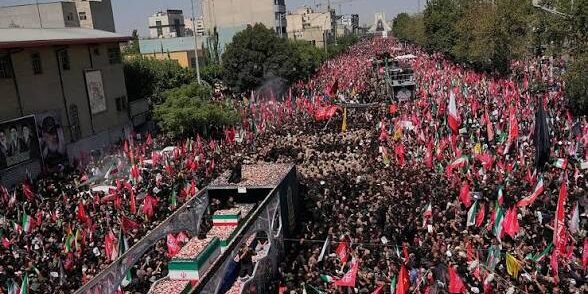
Funerals among Muslims, especially Shias, are very important ceremonies and a vital part of our yearly life. Today we are in Muharram, which is named after Imam Hussein. We know Muharram because of the incident of Karbala. In our culture, I believe martyrdom or passing away itself is not an end, but a transition to a higher state. We have a verse in the Quran that says not to consider martyrs as dead; they are alive. We see this in the incident of Karbala and what happened to Imam Hussein. Even though we are almost 14 centuries away from the Karbala incident, we say every day is Ashura, the 10th of Muharram, the day Imam Hussein was killed, and everywhere is Karbala. This means that after his martyrdom, he is more alive for our nations, our societies, and all Muslims. I believe the same is happening for Ayatollah Khamenei and his funeral. Arba’in, which we call the 40th day after a person dies, is a very important ceremony in our mourning traditions. For that reason, we are used to waiting a long time after losing loved ones to mourn deeply and honor them.
Because of the special situation our country faced during the war and after this temporary ceasefire we are in now, we waited not just days, but almost four months to be able to mourn the greatest sacrifice of modern history. I believe our Imam’s funeral will be the biggest event, the largest funeral not only in Iran, but one of the largest funerals in modern history, following the passing of Imam Khomeini, which was also a great event. But Imam Khomeini passed away naturally, while Ayatollah Khamenei was completely different. He was martyred by the worst people, along with his family, even a very young little girl, his granddaughter. I think it truly touched the hearts of many Iranians. I cannot easily express it in words. The most impactful part of his character for me was his unwavering commitment to his path and his ways. Why? Because he always tried to make clear what is right, while also saying that the right path comes at a cost. He said the most important thing for each of us is to know what is right, and no matter the cost, we must follow it. At the end, he mentioned a verse from the Quran, from Prophet Musa (Moses), saying: “Inna ma’iya rabbi sayahdeeni” which means “My God is with me and He will guide me.” He said: I do not care who is against me, who is trying to bring me to my knees – I know what is right, and my God is with me. Iranians call him “Agha,” which means “leader.” If I want to explain him to someone, I would say he is my man.