

In an age of information saturation, the gap between truth and perception has never been wider. Mainstream media, shaped by filters and biases, consistently offers a distorted image of Iran and its leadership to Western audiences. Against this backdrop, Ayatollah Khamenei took an extraordinary step: he addressed two open letters directly to the youth of Europe and North America. These were not conventional political statements but a philosophical invitation a call to think independently, to question established narratives, and to seek truth through direct engagement with primary sources. The Supreme Leader recognized that Western youth are naturally inquisitive, yet their access to authentic knowledge about Islam and Iran is systematically obstructed by media ecosystems that reduce complex realities to misleading soundbites and fragmented videos. The letters were designed specifically to bypass these gatekeepers and appeal directly to the intellectual autonomy of the younger generation.
The tone of the letters was notably respectful and empathetic. A central theme was terrorism a subject on which Western media have long cultivated widespread misconceptions. Ayatollah Khamenei reminded his young readers that Iran and the Muslim world have been the primary victims of terrorism, not its perpetrators. The Iranian people have suffered thousands of casualties over decades, a fact rarely acknowledged in Western reporting. By emphasizing that Iran is the “biggest victim” of terrorism, he was not merely defending his country but challenging the media‑narrated image that equates Islam with extremism. He invited the youth to read Islam’s foundational texts directly, rather than relying on secondary interpretations or hostile caricatures presented by the media. This was an epistemological challenge to the authority of media gatekeepers: trust your own reason, read for yourself, and then decide without allowing the media curtain to shape your understanding.
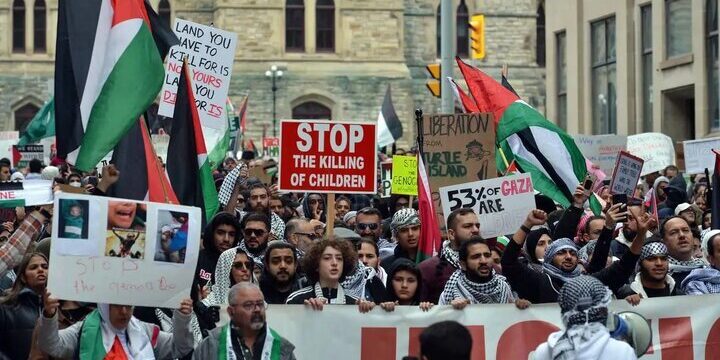
The impact of these letters became increasingly visible in subsequent years, particularly during the wars in Gaza and Lebanon. Massive protests erupted in Washington, London, Paris, and other major cities broad, diverse gatherings largely led by young people. Their vocabulary and moral framework directly mirrored the themes of the letters: rejection of media manipulation, a demand for unfiltered facts, and compassion for civilian victims regardless of nationality. Many of these protesters had been raised on one‑sided narratives, but the letters, combined with real‑time footage from conflict zones circulating on social media, created a powerful dissonance. They were not adopting a new ideology but asserting their right to independent thought precisely what the letters had encouraged. The media curtain had been lifted, and a new generation was seeing reality for themselves.
The Supreme Leader’s appeal was also a call to intellectual courage. He urged young Westerners not to accept the mediated version of Islam and Iran but to investigate directly. He told them that if they truly want to know about Islam, they should go to the original sources, not what the media tells them. This was not a religious prescription but a methodological one: a challenge to the hegemony of media narratives that have long shaped public opinion in the West. By addressing the youth directly, he bypassed the political and media establishments that normally mediate between Iran and the Western public. This direct appeal was itself an act of defiance against the media curtain a recognition that the younger generation, with its native skepticism and digital fluency, is the most likely to break through the filter.
The response to these letters, though initially muted in official circles, gradually manifested in the streets of Western capitals. Young people who had never before questioned the dominant narratives about Iran found themselves drawn to a more complex and honest picture. The letters gave them permission to doubt, to investigate, and to form their own conclusions. This was not about converting to a political cause but about reclaiming intellectual independence from the grip of hegemonic media systems. The Supreme Leader understood that the media curtain is not just a barrier to information but a barrier to empathy, to understanding, and to genuine human connection. By reaching out directly to the youth, he sought to tear down that curtain, one mind at a time.
In conclusion, the letters were far more than diplomatic curiosities. They were a strategic and philosophical intervention in the global battle for truth an appeal to the Western youth to look beyond the media curtain and engage with reality directly. By inviting young people to read primary sources, reconsider the nature of terrorism, and question the narratives they had been fed, Ayatollah Khamenei offered a path toward genuine understanding that requires neither the surrender of identity nor the renunciation of faith.