


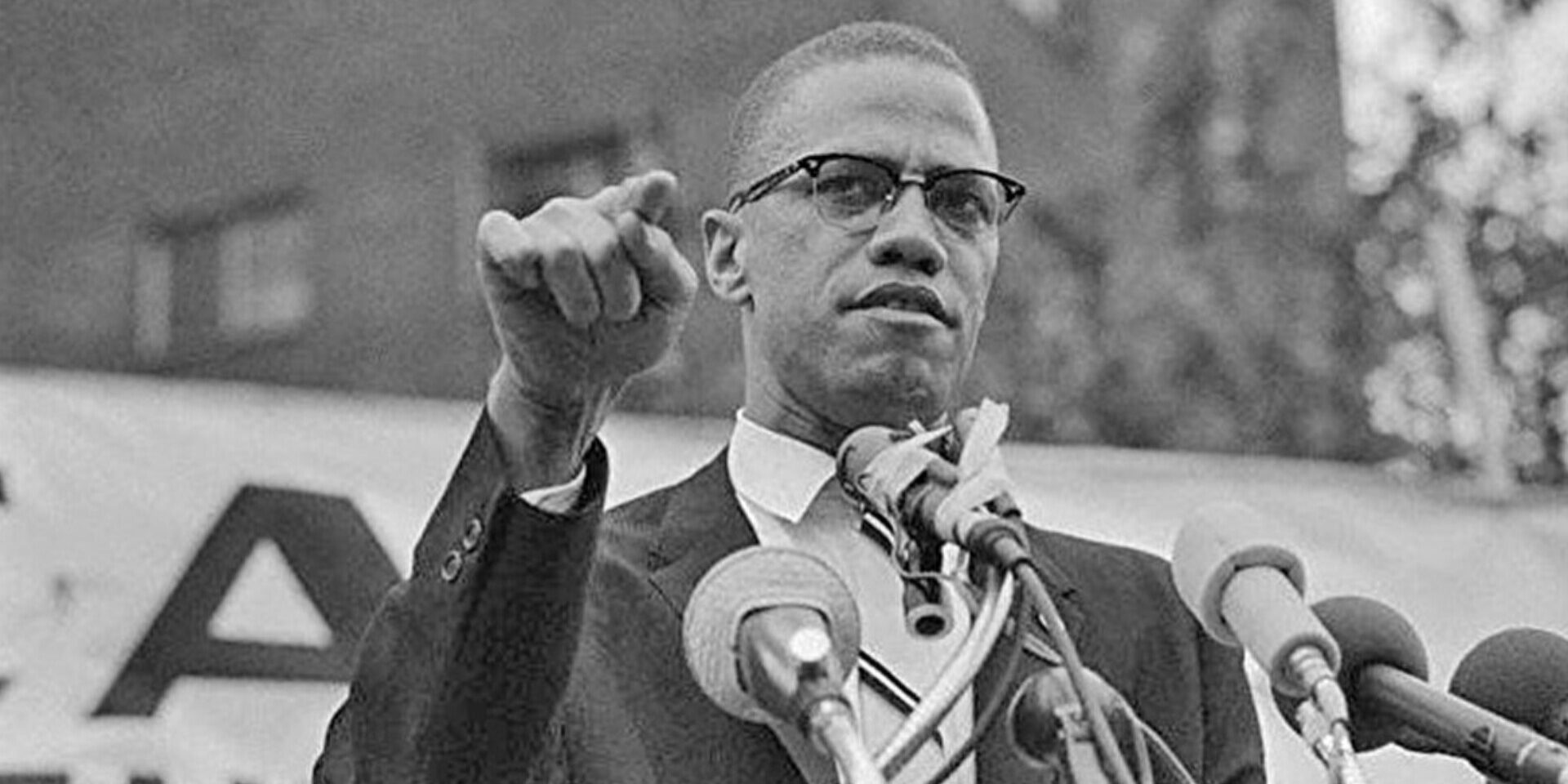
Malcolm X was one of the prominent African American thinkers. He was deeply engaged with what he called the “cancer of racism.” He believed that the United States was fundamentally built upon this cancer. If we were to translate this concept into contemporary philosophical language, we could say that Americans—or more precisely, white people, who may be aligned with Christian neoconservatives holding power in the White House and often referred to as “MAGA”—essentially see themselves as the “absolute subject” of the world. They believe others are either their subjects and servants, or “subjects” who must carry out their will in the world, rather than possessing independent will of their own.
Malcolm X refers to two concepts: “House Negro” and “Field Negro.” These concepts describe the condition of Black people in America. He explains that when Africans were brought to the American continent as slaves, they were divided into two groups: those who worked in the fields and those who lived in the houses of their white masters.
The difference between these two groups was that house slaves lived within the master’s household. The master would usually provide them with a small dwelling or shack and give them leftover food and clothing. These slaves constantly lived within the environment and presence of the master. In contrast, field slaves did not benefit from any of these privileges. They were forced to work under the scorching sun, rain, and snow, under the whip and lash, to increase the master’s production.
Malcolm X points out another crucial distinction: if the master became ill, or if there was war or any instability, the field slave would say to the house slave, “Let’s run away!” Or if a fire broke out, he would say, “Let’s burn the house and leave!”
- The house slave would respond: “Where would we go?”
- The field slave would say: “Let’s go be free!”
- “Free from what?”
- “Free from this master, free from these chains tied to our hands and feet!”
- But the house slave would reply: “What chains? What is freedom? What is liberation?”
At this point, Malcolm X explains that although the field slave’s life was full of hardship, suffering, and pain, he possessed something the house slave did not: subjectivity—an awareness of his own existence and identity. This determination allowed him to see a distance between himself and the master, rather than dissolving into the master’s being. He did not see himself as an extension of the master, but as a distinct and separate individual—not merely an object at the master’s disposal.
By contrast, when the master became ill, the house slave would say, “Are we sick?” instead of “Are you sick?” This shows that he saw himself as an extension of the master, having become absorbed into him.
Malcolm X highlights a key point here: a human being seeking liberation must possess subjectivity—that is, a distinct perspective and position. Otherwise, they will dissolve into the master–slave relationship.
In the current situation, Iran occupies a dual position. Many countries surrounding Iran are in a condition similar to that of the “house slave”; that is, they exist in a subordinate, master–servant relationship. For example, when an American base is attacked, countries such as Bahrain and United Arab Emirates appeal to the United Nations, asking why “their” country has been attacked. These countries do not perceive themselves as being like the “slave” Malcolm X describes—the one who goes to the master and asks, “Are we sick? Do we need medicine?” This slave has become so absorbed into the master’s existence that no distance remains between them; it is as if no independent “self” exists.
But Iran stands on the other side of this situation. Over the past two centuries, Iran has never been in the position of a “house slave,” although at certain times—especially after the United States became hegemonic on a global scale—it found itself in the position of a “field slave.” Nevertheless, given its civilizational and cultural background, it preserved its subjectivity within itself and made great efforts to achieve a position of liberation and complete independence from its master. This position was realized with the Islamic Revolution of Iran in 1979.
The recent war by the United States and Israel against Iran is a war against a nation and a government that has actualized its subjectivity in objective form. For this reason, Iran’s resistance provides an opportunity to reconstruct its subjectivity and freedom—and perhaps even for all humanity—to unveil the face of global imperialism.