Introduction: The Adaptive System and the “Vaccination” of a Sanctioned State
Contrary to prevailing forecasts of imminent collapse, the objective reality of the Iranian economy in 2026 reveals a deeply decentralized resilience and a sophisticated capacity for protracted conflict management. Tempered by five decades of systemic crises—from the eight-year war of the 1980s to unprecedented modern sanctions—the Iranian economy has effectively “vaccinated” itself against global financial and trade isolation. Guided by the “Resistance Economy” doctrine and bolstered by social cohesion, the state is now managed through a complex, indigenous parallel financial architecture.
Iran’s economic framework is specifically engineered to absorb maximum external pressure. This wartime resilience is built upon several critical pillars: coordinated macro-policy, infrastructure hardening, the maintenance of goods and energy flows, strategic commodity management, trade flexibility, and the aggressive regulation of financial markets.
Coordinated Macro-Policy: The Fiscal Pivot
A cornerstone of Iran’s resilience is a series of structural reforms that have functioned as economic shock absorbers. These measures represent a pivot toward fiscal discipline and logistical realignment. Notably, the share of tax revenues in the national budget has climbed to 53% of total public resources, while the share of oil, gas, and petroleum product exports has receded to 23.8%.
For the first time, the country’s core administration and public services are sustained by domestic capital flows rather than the volatility of global energy markets or maritime security threats. While this contractionary fiscal policy has induced short-term stagnation in the private sector, it serves as a necessary strategic trade-off to preserve economic sovereignty. This is complemented by a “Digital Rationing” system, detailed in the supply chain analysis below.
Strategic Infrastructure and Regional Interdependence
The backbone of the country’s survival lies in its “passive defense” strategies—efforts to protect critical infrastructure and sustain domestic production to eliminate import dependency. Despite kinetic strikes on certain industrial complexes, Iran’s power, refining, and petrochemical sectors remain operational through a model of dispersed operations and alternative networks. This is backed by a deterrent doctrine involving the potential disruption of energy infrastructure in both hostile and aligned neighboring states.
Crucially, these facilities were largely constructed using indigenous engineering, which accelerates post-war reconstruction and blunts the impact of technology sanctions. The government’s prior investment in small-scale, dispersed solar farms has also proven to be a vital defense asset. Furthermore, regional energy dependence—with Iraq, Turkey, Afghanistan, Pakistan, and Armenia relying on Iranian electricity and gas—has effectively linked Iranian security to regional stability. Iran now operates the most interconnected power grid in the region, facilitating direct and indirect energy imports from Russia and Central Asia.
Logistical Arteries: The Makran and Caspian Pivots
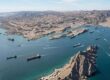
Geopolitically, Iran has moved to diversify its transit routes beyond the Strait of Hormuz. Exporters have transitioned toward direct loading from the Makran coast and secondary hubs in Oman and Pakistan, bypassing traditional re-export centers like the UAE.
To mitigate risks in southern ports, the North-South Corridor and Caspian Sea routes toward Russia and the CIS have become vital supplementary arteries. This logistical chain remains largely shielded from US-Israeli maritime intervention. A key asset here is the Solyanka Port in Russia’s Astrakhan economic zone, where the IRISL Group holds a 53% stake. As the leading terminal in the region, this port allows Iran to control the supply chain for strategic cargo—from grains to industrial components—directly from the source, bypassing Western customs bureaucracy and third-party sanctions.
Enhanced Ro-Ro and container vessel capacity in the Caspian, combined with the recent completion of the rail link to southern Caspian ports, has streamlined the movement of essential goods. Iran can now maintain strategic reserves of grain, livestock feed, and meat via Russia and Central Asia, while the Neka oil terminal acts as a “back door” for high-volume fuel imports, neutralizing the threat of a total Persian Gulf blockade.
Supply Chain Security: Digital Price Isolation
Iran’s resilience is heavily anchored in its self-sufficiency in essential goods. The provision of energy, bread, and basic necessities remains stable through a model of “Digital Price Isolation.” This system allows the government to insulate the “primary table” of lower-income deciles from wartime inflationary shocks without disrupting the entire distribution chain or creating artificial shortages. Operationally, the supply chain has remained flexible, utilizing a capillary network of 210,000 private-sector stores. This ensures that while goods flow at market prices for the general population, the purchasing power of vulnerable social layers is preserved.
Flexibility in International Trade and Legal Immunity
Before the current conflict, exports of Iranian metallic minerals, bitumen, petroleum derivatives, methanol, cement, and urea were already largely “sanction-proof” due to high global demand. As a top-five global exporter of these commodities, Iran’s removal from the market would cause significant disruption to global agriculture and downstream industries.
To maintain these markets, Iran has redefined international trade mechanisms through over-the-counter (OTC) contracts and complex barter agreements. By utilizing trustee companies and novel legal architectures, Iran has effectively neutralized “Country Risk” for its partners. These transactions often bypass the SWIFT system, utilizing cryptocurrency channels and indigenous exchange networks. Disputes are settled in mutually agreed-upon courts independent of Western banking standards, creating a layer of legal immunity for trade partners.
Liquidity Management and Financial Stability
Global wartime experience suggests that nations that control liquidity recover fastest. Iran’s Ministry of Economy and Central Bank have focused on ensuring that liquidity-driven inflation does not compound with wartime supply-shock inflation, thereby forestalling a hyperinflationary spiral.
The state has utilized a pre-tested network of exchange offices across the Far East, Europe, and regional hubs to stabilize the banking system and prevent capital flight. While these measures ensure the decentralized economy does not collapse, they come at the significant cost of infrastructure depreciation and a long-term reduction in GDP growth.
Conclusion: Challenging the Theory of Economic Coercion
Ultimately, Iran’s networked and decentralized economy challenges classical Western theories of “economic coercion.” Rather than the predicted sequence of hoarding and social collapse, the state has utilized existential threats as a catalyst for structural reform.
The absence of mass migration or widespread public anxiety, coupled with relative price stability following initial volatility, has defied the expectations of many independent analysts. Through the smart management of supply chains and food security, the phenomena of organized hoarding or famine have been largely avoided. This social stability is the system’s greatest asset. The costs currently incurred for survival represent a foundational investment for a post-war era in which Iran aims to emerge as an un-sanctionable energy and logistics hub in the shifting global order.
iraninsider